In industries, maintaining proper airflow is essential for efficient operations and safe working conditions. Industrial fans help regulate air circulation, supply the required air for combustion, and remove hot gases from the system. With reliable airflow management, industries can improve operational efficiency, maintain stable process conditions, and support the smooth functioning of their equipment.
Forced Draft (FD) fans and Induced Draft (ID) fans are two important types of industrial fans commonly used in boilers, power plants, furnaces, cement plants, and other industrial applications. Although both fans support air movement, their functions and positions in the system are different.
What Is an FD Fan?
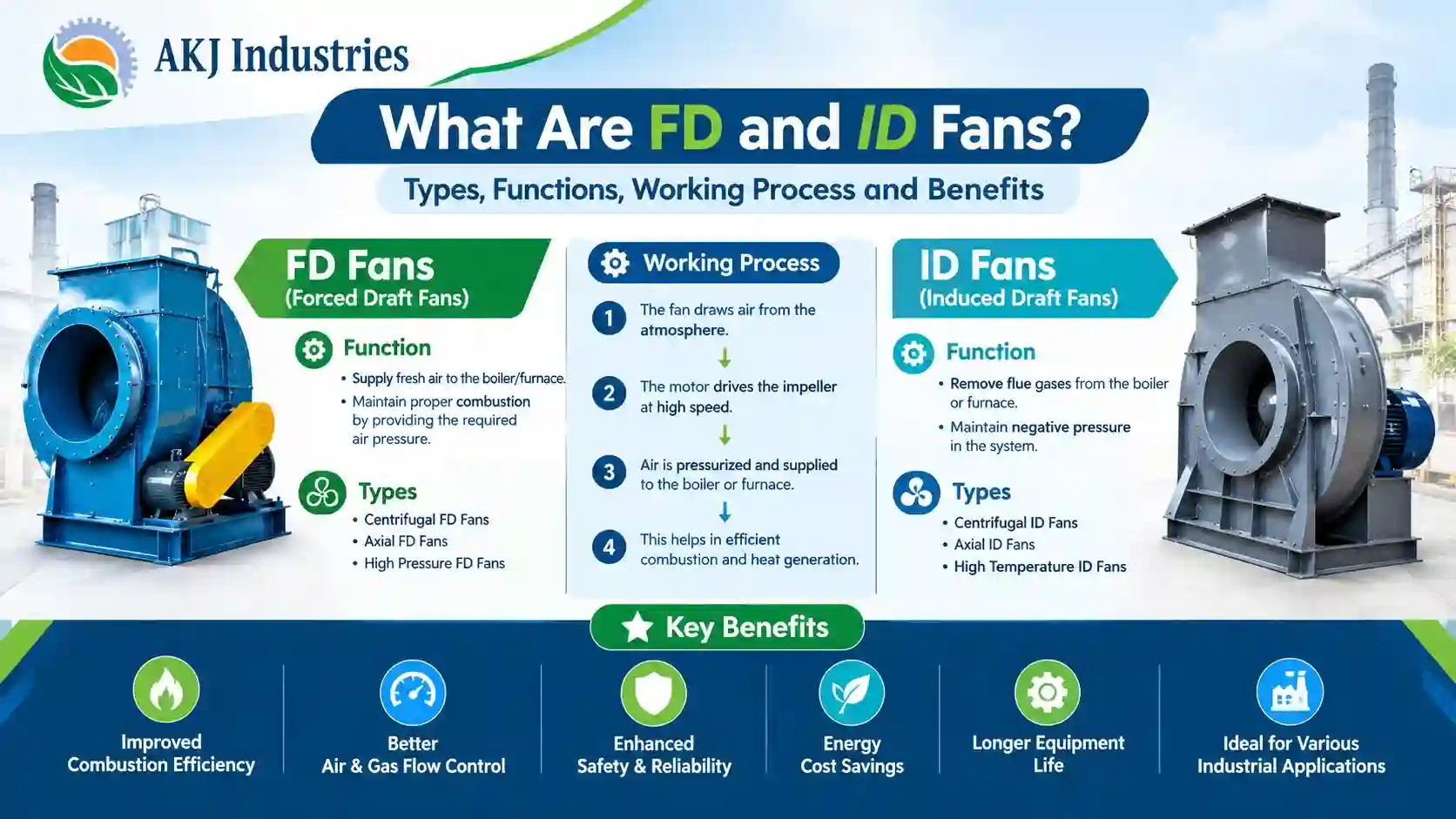
An FD fan, also known as a Forced Draft fan, supplies fresh air into a combustion system. It is generally installed before the combustion chamber or boiler furnace and pushes air into the system under positive pressure. This air provides the oxygen required for burning fuel efficiently.
FD fans are commonly used in industrial boilers, thermal power plants, heating systems, furnaces, and process industries. The required airflow depends on the type of fuel, combustion process, boiler capacity, and operating conditions.
A properly selected FD fan helps maintain a steady air supply, supports effective fuel combustion, and improves overall system performance.
What Is an ID Fan?
An ID fan, or Induced Draft fan, extracts flue gases from the boiler furnace and combustion system. It is generally installed downstream of the boiler and associated gas-cleaning equipment, depending on the plant configuration. The fan draws combustion gases through the system and directs them towards the chimney or exhaust outlet.
ID fans are important because they help maintain the required furnace pressure, often slightly below atmospheric pressure in conventional balanced-draft boiler systems. This helps prevent combustion gases from escaping into the surrounding working area.
AKJ Industries provides industrial fan solutions for applications where reliable gas handling, airflow management, and continuous operation are important considerations.
Working Process of an FD Fan
The working process of an FD fan begins when the electric motor drives the fan impeller. The rotating impeller draws fresh air through the inlet and accelerates it towards the outlet. This creates the pressure required to move air through ducts and into the combustion chamber.
The process generally involves the following steps:
- Air Intake: Fresh air enters the fan through the inlet.
- Air Acceleration: The rotating impeller increases the velocity and energy of the air.
- Pressure Development: The fan develops sufficient pressure to overcome resistance in the air ducts and combustion system.
- Air Supply: The air is delivered into the furnace or combustion chamber.
- Combustion Support: The supplied oxygen helps fuel burn under the required operating conditions.
In many industrial systems, airflow is adjusted according to boiler load and combustion requirements. Depending on the design, control may be provided through variable frequency drives, inlet dampers, outlet dampers, or other control arrangements.
Working Process of an ID Fan
An ID fan works by drawing flue gases through the boiler and exhaust system. The fan creates the pressure difference needed to move these gases through the connected equipment and discharge them safely.
Its working process typically includes the following stages:
- Flue Gas Generation: Fuel burns inside the furnace, producing hot combustion gases.
- Gas Movement: The gases pass through the boiler and associated heat-recovery equipment.
- Gas Treatment: Where provided, dust collectors, electrostatic precipitators, or other pollution-control equipment remove pollutants before the gases reach the fan.
- Gas Extraction: The ID fan draws the gases through the system and maintains the required draft.
- Exhaust Discharge: The gases move towards the chimney or designated exhaust outlet.
ID fans often operate under demanding conditions because flue gases may contain high temperatures, corrosive compounds, or residual particulate matter. Therefore, fan material, impeller design, temperature limits, and wear protection should be selected according to the actual application.
How does Forced draft fans function?
Forced Daft (FD) fans work by drawing fresh air from the atmosphere and supplying it to the boiler or furnace under pressure. This air provides the oxygen required for fuel combustion. FD fans help maintain a consistent air supply, support efficient burning, and improve the overall performance of industrial combustion systems.
How does induced draught fan function?
Induced Draft (ID) fans work by drawing hot flue gases from the boiler or furnace and directing them towards the chimney or exhaust system. They maintain the required negative pressure inside the furnace, helping prevent harmful gases from escaping into the workplace. ID fans support safe gas removal, proper airflow, and efficient industrial operations.
Important Features of FD and ID Fans
Industrial FD and ID fans are designed according to airflow, pressure, temperature, and operating requirements. Important features include:
- Robust Construction: Suitable structural materials support reliable performance under specified operating conditions.
- High Airflow Capacity: Fan selection is based on the volume of air or gas that must be moved.
- Pressure Capability: The fan must overcome resistance caused by ducts, heat exchangers, filters, and other equipment.
- Efficient Impeller Design: The impeller is selected to match the required airflow and pressure duty.
- Reliable Drive System: Motors, bearings, couplings, and gear arrangements are selected according to the fan design.
- Temperature Resistance: ID fans may require specialised materials and construction to handle hot flue gases.
- Maintenance Accessibility: Suitable arrangements for inspection, lubrication, and servicing can help simplify maintenance.
- Flow Control: Dampers or variable frequency drives may be used to regulate airflow according to operating requirements.
The final features depend on the fan model, process conditions, and application-specific design.
Applications of FD and ID Fans
FD and ID fans are used in many industries where combustion air supply or exhaust-gas extraction is required.
- Thermal Power Plants: Both fans support boiler combustion and flue-gas movement.
- Industrial Boilers: FD fans supply combustion air, while ID fans help maintain furnace draft and exhaust gases.
- Cement Plants: Industrial fans are used in combustion systems, kilns, and other process-air applications.
- Steel and Metal Industries: Fans support furnaces, heating systems, and exhaust arrangements.
- Chemical and Process Industries: Depending on the system design, FD and ID fans support heating, combustion, and gas-handling processes.
- Furnaces and Incineration Systems: These fans help manage combustion airflow and remove exhaust gases.
The fan type and configuration must be selected according to the temperature, pressure, gas composition, and dust concentration involved.
How to Select the Right FD or ID Fan
There are different types of ID Fan and FD Fan available according to the requirements of industrial operations. An industrial fan requires careful consideration of the system’s operating conditions. Before choosing a fan, industries should evaluate airflow requirements, static pressure, gas temperature, gas density, and the resistance created by connected equipment.
For ID fan applications, dust loading, corrosive gases, abrasion, and gas-cleaning arrangements are also important factors. For FD fans, combustion-air temperature, duct resistance, and required oxygen supply should be considered.
Motor power, impeller material, operating speed, efficiency, maintenance access, and control requirements also influence fan selection. Proper engineering calculations help ensure that the fan can meet the required duty without unnecessary energy consumption or operational problems.
Why Choose AKJ Industries for Industrial ID Fans?
AKJ Industries focuses on industrial fan solutions designed around practical operating requirements. When selecting an ID fan, industries need equipment that can handle the required gas volume, pressure, and operating conditions while supporting dependable performance.
Important considerations include robust construction, suitable impeller design, reliable drive components, and compatibility with the application. AKJ Industries serves industrial requirements where airflow management and dependable fan operation are essential to the production process.
For businesses searching for ID fan manufacturers for boiler systems, industrial furnaces, or power plant applications, discussing the actual operating conditions with the manufacturer is an important step towards selecting suitable equipment.
Conclusion
FD fans and ID fans perform different but complementary roles in industrial combustion systems. FD fans supply the air required for combustion, while ID fans extract flue gases and help maintain the required furnace draft. Their proper selection and coordinated operation contribute to stable combustion, efficient airflow, and safe exhaust-gas handling.
AKJ Industries is a name to consider when exploring industrial ID fan solutions. By evaluating airflow, pressure, temperature, gas composition, and plant requirements, industries can select equipment suited to their operational needs.