Industrial manufacturing processes often generate large amounts of dust, metal particles, wood chips, cement dust, and other airborne contaminants. Without proper dust control, these particles can affect employee health, reduce machine efficiency, and create an unsafe working environment. A Cyclone Dust Collector is one of the most effective and economical solutions for removing dust from industrial air streams.
In industries dust, debris, and fine particles are produced during manufacturing is a critical concern. It is important to maintain clean air for both worker safety and equipment longevity. One of the most effective and economical solutions for air pollution control is the Cyclone Dust Collector.
AKJ Industries, a leading cyclone dust collector manufacturer, designs high-performance systems that ensure efficient dust separation and a clean work environment. In this blog, we explain how a cyclone dust collector works and ensure it helps you understand it.
What is Cyclone Dust Collector?
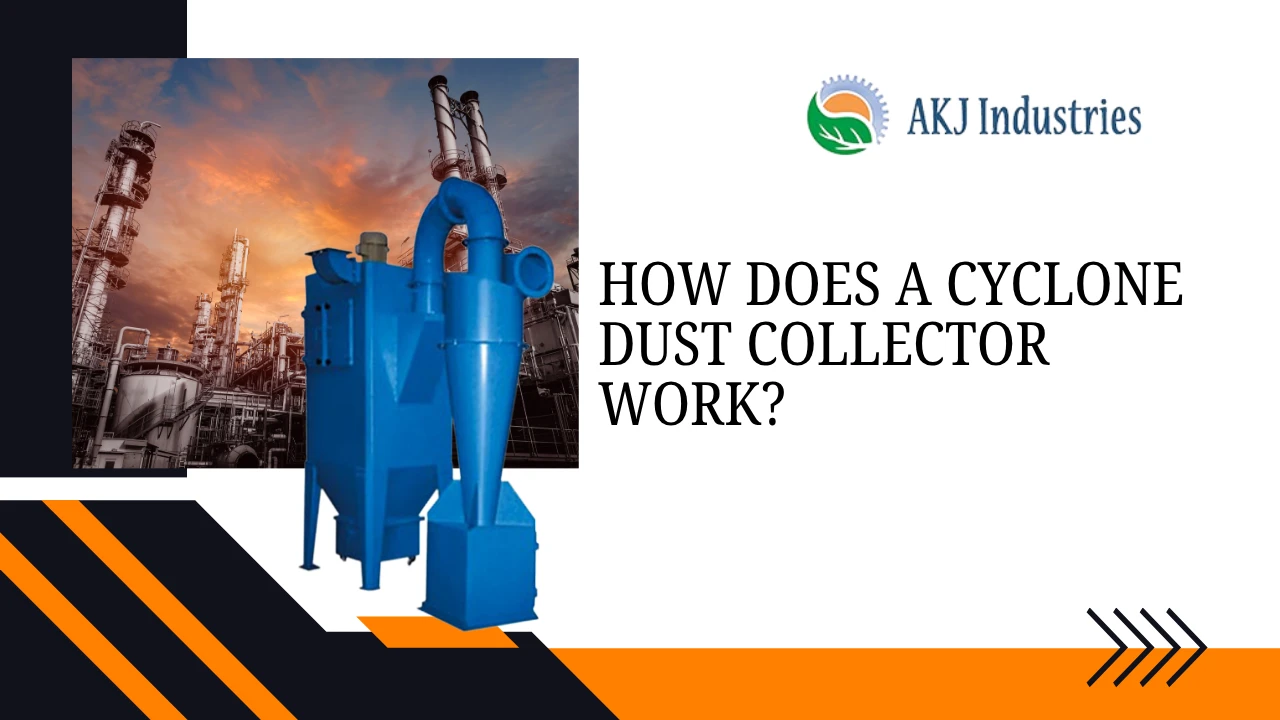
A Cyclone Dust Collector is a mechanical device that removes dust and particulate matter from air or gas without using filters. It uses the principle of centrifugal force to separate heavier particles from the airstream.
These dust collectors are widely used in industries like cement, metal processing, woodwork, food, and chemical manufacturing — where large volumes of dust are generated.
How Does a Cyclone Dust Collector Work?
The working principle of a cyclone dust collector is simple yet highly efficient. It separates dust particles by creating a powerful spinning motion inside the cyclone chamber.
Step 1: Dust-Laden Air Enters the Cyclone
Dust-contaminated air enters the cyclone through the inlet at high velocity. The inlet is designed to direct the airflow in a circular path inside the cyclone body.
Step 2: High-Speed Rotational Motion
As the air enters, it begins rotating rapidly inside the cylindrical chamber. This creates a strong centrifugal force that pushes heavier dust particles toward the outer wall of the cyclone.
Step 3: Dust Separation
The dust particles lose their momentum after striking the cyclone wall and gradually move downward into the conical section due to gravity.
Step 4: Dust Collection
The separated dust falls into the collection hopper or dust bin located at the bottom of the cyclone. The collected dust can be easily removed for disposal or recycling.
Step 5: Clean Air Discharge
After most of the dust has been removed, the cleaner air forms an inner upward spiral and exits through the outlet at the top of the cyclone.
This continuous process ensures efficient dust removal while maintaining smooth airflow throughout the system.
Working Principle of Cyclone Dust Collector
- Works on the centrifugal force principle.
- Dust-laden air enters the cyclone tangentially at high speed.
- The air spins in a circular vortex motion inside the chamber.
- Heavier dust particles are thrown toward the outer wall.
- Due to gravity, these particles slide down into the dust hopper.
- Clean air moves upward through the center of the cyclone.
- Air exits through the top outlet, leaving dust collected below.
- No filters are used — ensures low maintenance and continuous operation.
- Efficiency depends on air velocity, particle size, and cyclone design.
Components of a Cyclone Dust Collector
- Cylindrical Body: For air spinning and initial dust separation.
- Conical Section: Directs heavy particles downward.
- Inlet & Outlet Ducts: Control airflow direction and speed.
- Dust Discharge Valve: Allows easy removal of collected dust.
Advantages of Cyclone Dust Collectors
- High Efficiency: Removes up to 90–95% of larger dust particles.
- Low Maintenance: No filters or moving parts reduce maintenance needs.
- Durability: Built with heavy-duty materials for long service life.
- Cost-Effective: Simple design and low operational costs.
- Versatile Use: Suitable for a wide range of industrial processes.
Applications of Cyclone Dust Collectors
- Cement and concrete plants
- Metal grinding and cutting units
- Food and grain processing plants
- Woodworking and sawmills
- Foundries and boiler systems
AKJ Industries– Leading Cyclone Dust Collector Manufacturer
AKJ Industries is a trusted name in air pollution control equipment manufacturing, offering high quality Cyclone Dust Collectors designed for maximum efficiency and durability. We always prioritize customer satisfaction and ensure they feel happy with every use of our products. With the trust of innovation and quality, we provide customized solutions for various industrial needs.
Our dust collectors are made from high-grade steel, designed for easy installation, minimal maintenance, and long-term reliability. Our commitment to performance and customer satisfaction has made us a preferred choice across multiple industries in India.
Conclusion:
A Cyclone Dust Collector is one of the simplest and most effective devices for maintaining clean and safe air in industrial environments. Its efficient design, low cost, and durability make it an essential component of any dust control system.
If you’re looking for a reliable and high-quality Cyclone Dust Collector, AKJ Industries stands out as a leading manufacturer, delivering advanced solutions that ensure cleaner air and better productivity.