Centrifugal blowers are essential air-handling devices used across industries for ventilation, dust control, fume extraction, aeration, drying, and more. Their efficiency, reliability, and ability to move large volumes of air at stable pressure make them one of the most widely used industrial blowers today. As a trusted manufacturer in the air-handling segment, AKJ Industries designs high-performance centrifugal blowers that deliver consistent airflow and long-term operational stability.
In this blog, we’ll explore the working principle of centrifugal blowers, how they function, and why they are preferred in industrial applications.
What is Centrifugal Blower?
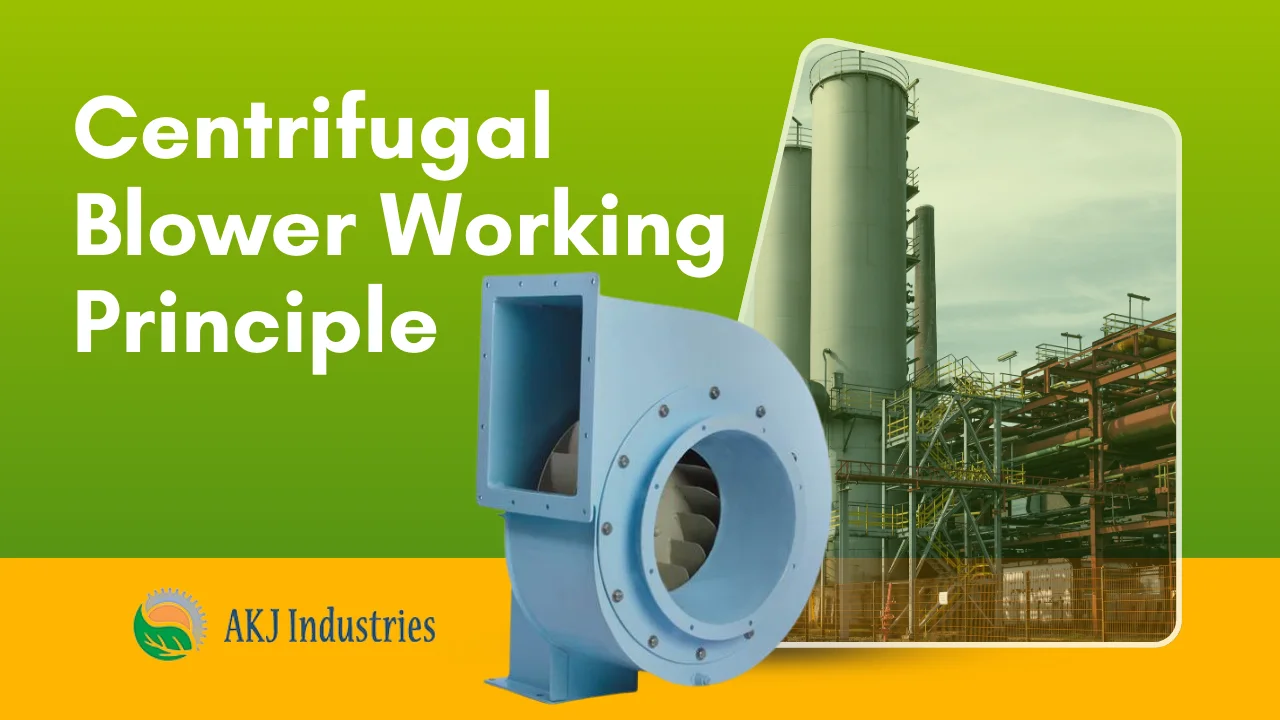
A centrifugal blower is a mechanical device that uses the concept of centrifugal force to move air or gas. The air enters the center of the rotating impeller, is thrown outward by the impeller blades, and exits the blower housing at a higher pressure.
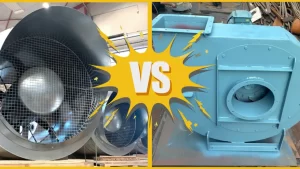
Unlike axial fans, which move air parallel to the shaft, centrifugal blowers move air perpendicular to the incoming air direction. This design enables higher pressure generation, making them ideal for industries that require controlled airflow.
Centrifugal blowers come in different configurations such as single-stage, double-stage, high-pressure, medium-pressure, and low-pressure models. AKJ Industries manufactures all types of centrifugal blowers, tailored to suit dust collection units, HVAC systems, boilers, furnaces, paint booths, pneumatic conveying systems, and more.
Working Principle of a Centrifugal Blower
The working principle of a centrifugal blower can be understood in four main steps:
1. Air Intake Through the Inlet (Suction Side)
The blower starts its operation when air or gas is drawn into the inlet, usually located at the center of the impeller, known as the “eye.”
This happens because the rotating impeller lowers the pressure at the center, creating a suction effect. Fresh air continuously flows into this low-pressure zone, ensuring steady operation.
Key points:
- The inlet guides air smoothly into the impeller.
- Air enters axially (straight line) before changing direction.
- Pressure difference is created due to impeller rotation.
2. Impeller Rotation Creates Centrifugal Force
The impeller is the heart of the centrifugal blower. It contains a series of blades that rotate at high speed.
When the impeller rotates, it imparts kinetic energy to the air, causing it to move rapidly toward the periphery (outer side).
This phenomenon occurs due to centrifugal force. Just like water being flung outward in a spinning bucket, air is forced outward when the impeller spins.
Impeller design impacts efficiency:
- Forward-curved blades = high airflow, low noise
- Backward-curved blades = high efficiency, higher pressure
- Radial blades = dust and particle-handling capability
3. Conversion of Velocity Energy to Pressure Energy
Once the air exits the impeller blades at high velocity, it enters the blower housing, also known as the volute casing.
Here, the high-speed air slows down due to the shape of the casing, and the kinetic energy is converted into pressure energy.
This principle is based on Bernoulli’s equation, where reduced velocity increases pressure.
The volute helps in:
- Streamlining the airflow
- Preventing turbulence
- Improving pressure buildup
- Ensuring uniform discharge
As a result, the blower delivers consistent pressure at the outlet.
4. Air Discharge Through the Outlet
Finally, the pressurized air is pushed out through the discharge port at a desired pressure and flow rate.
The blower outlet can be connected to ducts, pipelines, dust collectors, heating systems, ventilation ducts, or industrial machinery depending on the application.
Discharge air characteristics:
- Higher pressure than inlet air
- Uniform and continuous airflow
- Controlled volume and direction
- Applications of Centrifugal Blowers
Industries that widely use centrifugal blowers include:
- Cement & steel plants
- Chemical and pharmaceutical units
- Textile mills and food processing plants
- Manufacturing factories
- Foundries and boiler rooms
- HVAC and ventilation systems
- Pollution control and dust extraction systems
- Paint booths and spray rooms
- Types of Centrifugal Blowers
Centrifugal blowers are available in different designs and pressure ranges, making them suitable for a wide variety of industrial and commercial applications. Below are the major types and their uses:
1. High-Pressure Centrifugal Blowers
High-pressure blowers are built to deliver strong airflow at high static pressure. These models have reinforced impellers and sturdy housings, allowing them to perform reliably even in demanding conditions.
Common Applications:
- Boilers and industrial burners
- Furnaces and heat-treatment systems
- Pneumatic conveying of powder or granules
- Combustion air supply for industrial processes
- High-resistance ducting systems
These blowers are ideal when powerful, consistent airflow is required over long distances or through complex pipelines.
2. Medium-Pressure Centrifugal Blowers
Medium-pressure blowers balance airflow volume and pressure, making them versatile for general industrial use. They offer stable performance without high power consumption.
Common Applications:
- HVAC systems and air handling units
- Fume extraction and filtration units
- General industrial ventilation
- Dryers and cooling equipment
These blowers are preferred for environments where steady airflow is essential but extreme pressure is not required.
3. Low-Pressure Centrifugal Blowers
Low-pressure blowers are designed for high-volume airflow at lower pressure. They are lightweight, energy-efficient, and suitable for continuous, large-area air movement.
Common Applications:
- Equipment cooling and machine ventilation
- Fresh-air supply in buildings
- Drying systems in food, textile, and paper industries
- Lightweight dust and fume extraction
- They work well in applications that need large airflow without heavy load or back pressure.
4. Direct Drive & Belt Drive Centrifugal Blowers
Centrifugal blowers are also classified based on their drive mechanism, which affects speed, efficiency, and maintenance.
Direct Drive Blowers
In these models, the motor is directly connected to the impeller.
Advantages:
- Low maintenance
- Compact and space-saving design
- Higher reliability with fewer moving parts
- Energy efficient for continuous operation
Best for small to medium-duty applications where fixed speed is acceptable.
Belt Drive Blowers
These blowers use a belt and pulley mechanism to drive the impeller, allowing better speed and pressure control.
Advantages:
- Adjustable speed for precise airflow requirements
- Suitable for high-power and heavy-duty operations
- Easier to customize according to process needs
- Ideal for industrial setups where variable air volume and pressure are needed.
Advantages of Centrifugal Blowers
Industries prefer centrifugal blowers due to:
1. High Pressure Capacity: Unlike axial fans, centrifugal blowers can generate significantly higher pressure.
2. Stable Airflow: Perfect for processes requiring controlled movement of air or gases.
3. Strong and Durable: Built to handle high dust load, moisture, and continuous operation.
4. Versatile Applications: Used in dust collectors, HVAC units, industrial furnaces, paint booths, and more.
5. Low Maintenance: Durable bearings, balanced impellers, and robust construction minimize maintenance needs.
6. Energy Efficient: Backward-curved impellers and improved volute designs help save energy.
Conclusion:
The centrifugal blower operates on a simple yet powerful working principle: using centrifugal force produced by a rotating impeller to convert kinetic energy into air pressure. This process ensures efficient airflow, making centrifugal blowers indispensable in industries that depend on stable ventilation, dust control, heating, cooling, and fume extraction.
With their expertise, AKJ Industries high-performance centrifugal blowers manufactures built for efficiency, durability, and long-term reliability. Our engineering excellence and focus on quality make us a preferred choice for industrial air-handling solutions.