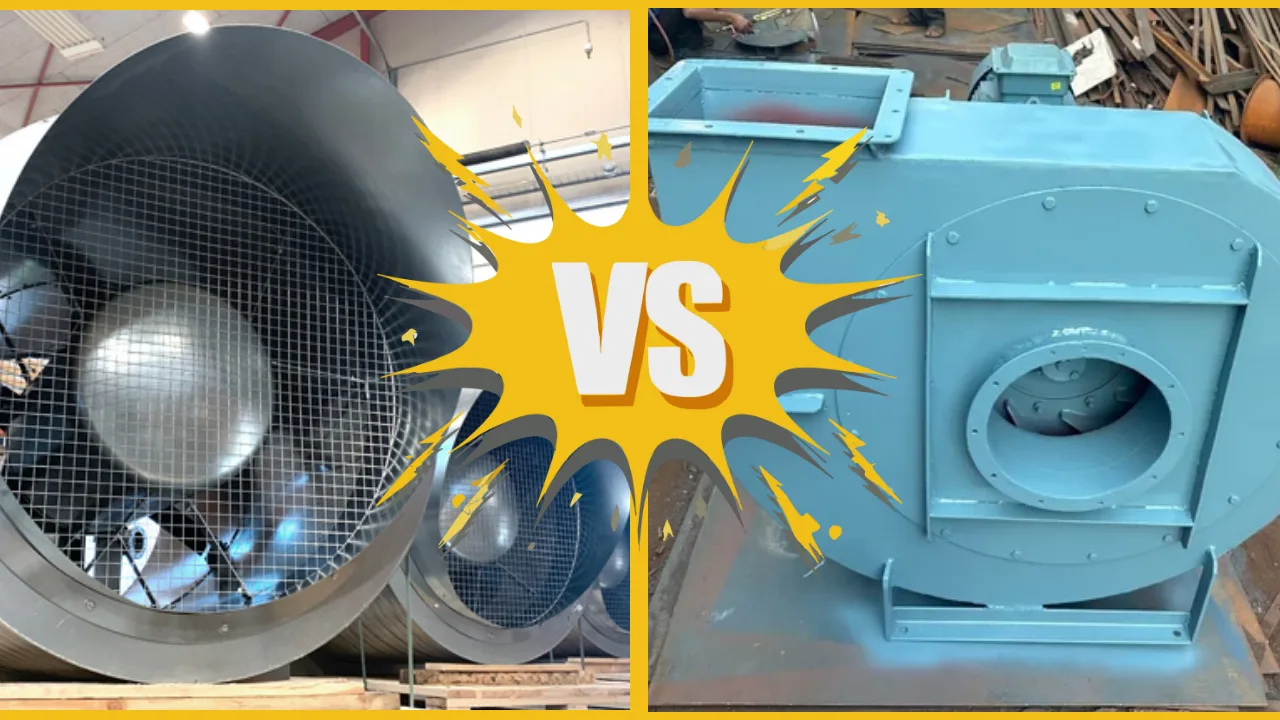
In industrial ventilation and air handling systems, choosing the right air-moving equipment is very important. For ventilation, industries depend on two most common options: centrifugal blowers and axial fans. While both are designed to move air, their working principle, performance, and applications are quite different. Understanding these differences helps industries select the right solution for better efficiency, safety, and long-term performance.
In this blog, we are trying to explain centrifugal blowers vs axial fans, focusing on their key differences, working principles, and uses.
What Is a Centrifugal Blower?
A centrifugal blower works on the principle of centrifugal force. Air enters the blower near the center of the rotating impeller. As the impeller spins, it throws the air outward at a right angle (90 degrees) to the intake direction. This action increases the air pressure before it exits through the outlet.
Working of a Centrifugal Blower
- Air enters through the inlet at the center of the impeller
- The rotating impeller accelerates the air outward
- Air pressure increases due to centrifugal force
- High-pressure air exits through the casing outlet
Centrifugal blower fan are known for generating high pressure, which makes them suitable for systems where air needs to travel through ducts, filters, bends, or resistance-heavy setups.
Uses of Centrifugal Blowers
Centrifugal blowers are widely used in industries that require controlled airflow at higher pressure. Common applications include:
- Dust collection systems
- Industrial exhaust and ventilation systems
- Boilers and furnaces
- Air handling units (AHUs)
- Cement plants, steel plants, and power plants
- Pollution control equipment
Manufacturers like AKJ Industries design centrifugal blowers using robust materials to ensure durability, consistent airflow, and long service life in demanding industrial environments.
What Is an Axial Fan?
An axial fan moves air parallel to the axis of rotation. The airflow direction is similar to that of a ceiling fan. Axial fans are mainly designed to move large volumes of air at low pressure.
Working of an Axial Fan
- Air enters straight along the fan axis
- Rotating blades push air forward in the same direction
- Air exits with high volume but low pressure
Axial fans are simple in design and consume less space, making them suitable for applications where airflow resistance is minimal.
Uses of Axial Fans
Axial fans are commonly used where large airflow is required without much resistance. Typical applications include:
- General ventilation
- Cooling towers
- HVAC systems
- Heat exchangers
- Warehouses and factories
- Cooling of motors and equipment
Because of their simple construction, axial fans are often cost-effective and easy to maintain.
Centrifugal Blower vs Axial Fan
Working Principle
- Centrifugal Blower: Air enters from the center and is thrown outward at a 90° angle using centrifugal force.
- Axial Fan: Air moves straight along the axis of the fan, similar to a ceiling fan.
Air Pressure
- Centrifugal Blower: Generates high air pressure.
- Axial Fan: Works at low air pressure.
Air Volume
- Centrifugal Blower: Delivers moderate airflow.
- Axial Fan: Delivers high airflow volume.
Applications
- Centrifugal Blower: Used in dust collectors, exhaust systems, boilers, and industrial ventilation.
- Axial Fan: Used for general ventilation, cooling systems, warehouses, and HVAC applications.
Suitability
- Centrifugal Blower: Best for ducted systems with resistance.
- Axial Fan: Best for open areas with minimal resistance.
Which One Should You Choose? Axial and Centrifugal Fan
The choice between a centrifugal blower and an axial fan depends mainly on application requirements.
Choose centrifugal blower if:
- You need high-pressure airflow
- Air has to move through ducts, filters, or cyclones
- Dust, fumes, or hot air needs to be handled
- Industrial processes demand consistent performance
Choose an axial fan if:
- You need large airflow with low resistance
- Simple ventilation or cooling is required
- Space and budget are limited
- Pressure requirement is minimal
Conclusion
Both centrifugal blowers and axial fans play a crucial role in industrial ventilation and air handling systems. While axial fans are ideal for moving large volumes of air at low pressure, centrifugal blowers are better suited for high-pressure, resistance-heavy applications. AKJ Industries manufactures centrifugal blowers and fans that deliver reliable performance under tough operating conditions. Our products are designed to meet industry standards and customer-specific requirements, ensuring efficiency, safety, and long operational life.
Selecting the right option improves efficiency, reduces energy consumption, and ensures smooth operations.
With experienced manufacturers like AKJ Industries, industries can rely on well-designed, durable, and efficient air movement solutions tailored to their specific needs.